
Policy Solutions for Bird Collisions with Buildings
FLAP Canada advocates for all levels of government to improve protections for birds. Your voice is critical to these efforts.
Canada started a global movement to protect birds, yet there is critical work left for us to do at home.
For nearly 30 years, FLAP Canada has been at the leading edge of developing evidence-based measures for mitigating and avoiding bird collisions with buildings. Beginning with the City of Toronto enacting the first bird safe buildings policy in the world, FLAP Canada has since collaborated with numerous municipal partners to support their development of similar programs and policies. Together, these measures promote the adoption of bird safe glazing (glass) in building construction and major renovations, as well as lighting design that minimizes light pollution.
Today, much of FLAP Canada’s work focuses on solutions that can be implemented by governments through public policy, both here in Canada and around the world. We support individuals and partners to advocate for birds across jurisdictions, recognizing migratory birds know no borders and their protection is a shared responsibility.
All three levels of government in Canada have roles to play in reducing bird collisions with buildings.
How do laws in Canada protect birds?
In Canada, protections exist for birds at all three levels of government. However, it is important to note that each level of government (municipal, provincial, federal) has different jurisdiction – meaning they can only develop and enforce protections that are within their legal authority.
The division of law-making powers between the federal government and the provincial and territorial governments is laid out in Sections 91 and 92 of Canada’s Constitution Act (1867). Municipalities are “creatures of the provinces and territories” and derive all of their authority to create and enforce municipal laws from provincial and territorial legislation and regulations.
For instance, provinces and territories hold authority to regulate natural resources and building construction, while the federal government holds authority to regulate nation-wide protections for migratory birds such as the Species at Risk Act and the Migratory Birds Regulations (under an international Treaty with the United States). Municipalities can regulate certain aspects of building construction through their local planning process, such as site plan control. However, the scope of this municipal authority varies between provinces, as well as between the City of Toronto and other Ontario municipalities.
Shared Jurisdiction
-
Prohibition on killing migratory birds – Under the Migratory Birds Regulations (2022) which implement measures of the Migratory Birds Convention Act, the prohibition on incidental take includes building owners killing listed migratory birds by allowing collisions with buildings to occur, even unintentionally. Building owners who are the subject of complaints submitted to the Canadian Wildlife Service may be contacted by federal law enforcement. Failure to comply with the regulations may result in financial penalties per offence (i.e., per bird). The Regulations apply to lower levels of government, including provinces, territories and municipalities.
Prohibition on killing bird Species at Risk – Under the Species at Risk Act, it is illegal to injure or kill a listed bird species, including by causing collisions with buildings. Building owners who are the subject of complaints submitted to the Canadian Wildlife Service may be contacted by federal law enforcement. Failure to comply with the regulations may result in financial penalties up to $1 million per offence (i.e., per bird). The Act applies to lower levels of government, including provinces, territories and municipalities.
Recovery Strategies for bird Species at Risk – Under the Species at Risk Act, once a species has been listed as endangered, threatened, or extirpated, the competent federal minister has a legal mandate to prepare, and then implement a recovery strategy for that species. Published recovery strategies make references to research and management approaches the government is committed to undertake. For example, the recovery strategy for the Canada Warbler indicates the government will: “Review policies regarding window design for federal and non-federal buildings along migration routes to reduce likelihood of window collisions and develop regulations and incentives to make windows less prone to bird strikes along Canada Warbler migration routes.”
Mitigating collisions at federal buildings – Under the Greening Government Strategy, the federal government has committed all departments to review and mitigate bird collisions occurring with federally-owned buildings in their respective portfolio.
National Master Construction Specification – Canada’s leading specification for building construction has been updated to include references to the CSA A460 Bird Friendly Building Design standard.
National Capital Commission (NCC) Bird-Safe Design Guidelines – These guidelines are aligned with CSA A460 and are mandatory for federal building construction in the National Capital region
-
Provinces and territories hold jurisdiction over natural resources and regulation of building construction. In general, there are no known provincial or territorial policies dedicated to mitigating or avoiding bird collisions with buildings. FLAP Canada recognizes provincial inaction as posing a critical gap for reducing collisions across Canada.
Following advocacy by FLAP Canada and other individuals and organizations, numerous buildings owned by the provincial government in Ontario have been treated for bird safety, such as visitor centres in provincial parks, the Whitney Block at Queen's Park, and the Ministry of Finance Building in Toronto.
In principle, provincial and territorial laws and regulations containing prohibitions on killing listed Species at Risk may apply to collisions with buildings. However, there are no known precedents for these laws being enforced in the context of collisions with buildings.
There are precedents in Ontario for broader environmental laws being applicable to collisions. In 2010, charges were laid against Menkes Developments and several related companies for violating Ontario’s Environmental Protection Act as well as the Ontario Society for the Prevention of Cruelty to Animals Act. Those charges were later dropped as the buildings were treated by the owner for bird safety.
Later, in 2013 the Ontario Superior Court of Justice ruled in Podolsky v Cadillac Fairview Corp. that the defendant had contravened Ontario’s Environmental Protection Act (as well as the federal Species at Risk Act) by causing birds to collide with glass on a building. Specifically, the judge concluded that the Environmental Protection Act prohibition on discharging a contaminant into the environment includes radiation in the form of light being reflected off the building, which was shown to cause an adverse effect. Cadillac Fairview and related companies were later acquitted of the charges because they had begun to treat their building and thus demonstrated due diligence.
-
Numerous municipalities in Canada have adopted bird safe design standards such as CSA A460 Bird Friendly Building Design into local policies, such as bylaws for site plan control, official plans, asset management plans, and procurement frameworks for public facilities. Generally, municipal policies only regulate certain categories of buildings (e.g., commercial, multi-unit residential) and exclude single-detached homes, which are the most numerous type of structure on the landscape that poses risk for birds.
Although municipal protections for birds were invented and first adopted in the City of Toronto, legislative changes made by the Government of Ontario in 2026 appear to have removed the authority of Ontario municipalities to require bird safe design through their local planning process. The enforceability of existing municipal protections remains undetermined. Municipalities, as well as provinces and territories, are expected to comply with the federal Migratory Birds Regulations (2022) and Species at Risk Act, including their respective prohibitions on incidental take.The following links can provide information to identify which municipalities in Canada have adopted voluntary or mandatory measures for bird safe buildings into their local policies.
Nature Canada: Bird Friendly Cities certification applications (click the application link in the description for each point on the map; see pages 16, 17, 18)
Do you know of a Canadian municipality with a bird protection policy that is missing from resources linked above? If so, please contact birdsafe [at] flap [dot] org to let us know.
-
Several institutions in Canada, such as post-secondary campuses and transit agencies, have voluntarily adopted a bird safe design standard into their internal policies and guidelines supporting building construction and development. The implementation of standards varies between institutions, and is generally not subject to legal enforcement.
As of 2025, universities in Ontario are now exempt from municipal planning authority. In effect, this means municipal policies regulating building design no longer apply to developments on campuses.
Examples of institutional policies include:
Existing Protections
Policy Solutions: How Governments Can Improve Protections for Birds
-
Environment and Climate Change Canada must enforce the Migratory Birds Regulations (MBR) prohibition on incidental take which applies to collisions with buildings involving listed species.
Environment and Climate Change Canada must enforce the Species at Risk Act (SARA) regulations prohibition on incidental take which applies to collisions with buildings involving listed species.
The National Research Council of Canada issues the National Building Code of Canada. This model building code sets technical rules for designing, building, altering, and tearing down structures. It is free to read online, but it only becomes law when local or provincial governments choose to use it.
Federal programs providing funding for housing and other forms of development should require bird safe design to be included in all projects, ensuring program support recipients comply with all federal regulations.
Modify existing financial support programs for building retrofits (e.g., climate resilience, energy performance) to include bird safe glazing in project eligibility criteria. Cost is a major barrier to making existing buildings bird safe. Reducing this barrier would help more building owners to voluntarily comply with federal regulations.
The National Research Council of Canada can invest in research and technological innovation in building construction, design and retrofitting for bird safety, aimed at reducing the cost to bring existing buildings into compliance with federal regulations.
Set design standards and guidelines used by industry, such as for modular construction.
-
Regulate bird safe design in all building construction through a Building Code, such as by adopting references to the CSA A460 Bird Friendly Building Design standard into Code. In Canada, only provincial and territorial governments have the authority to regulate building construction.
Adopt legislation that provides municipalities with sufficient authority to enact bylaws, official plans and related policies to protect birds through their local planning process.
Allocate capital funding through programs for housing and other forms of development as well as retrofits to support building owners and developers adopting mitigation and avoidance measures for bird collisions.
Set design standards and guidelines that are used by industry, such as by embedding references to the CSA A460 Bird Friendly Building Design standard in sections specifying requirements for glazing and outdoor lighting.
Ensure bird safe design is reflected in publicly owned buildings, such as by adopting references to the CSA A460 Bird Friendly Building Design standard into design guidelines, procurement policy, etc.
Increase funding for arts programs that can provide funding to support applications of certain types of bird collision mitigation, such as custom artwork and murals on glass.
Enforce provincial and territorial environmental laws which may include prohibitions on killing or injuring birds identified as Species at Risk;
Regulate and inform professions that lead the design and operation of buildings and landscape, such as architecture, about best practices and shared conservation objectives.
-
Enact requirements through the local planning process for new developments, such as by adopting the CSA A460 Bird Friendly Building Design standard into a site plan control bylaw or urban design guideline. Note: Recent changes to provincial legislation in Ontario downgraded existing municipal requirements to voluntary recommendations that cannot be enforced.
Set standards for construction of new municipal public facilities, such as by adopting references to the CSA A460 Bird Friendly Building Design standard into design guidelines, procurement policy, etc.
Set standards for maintenance and renovation of existing public facilities including window upgrades, such as by adopting a reference to the CSA A460 Bird Friendly Building Design standard into asset management framework, procurement policy, etc.
Undertake a risk assessment of bird collisions at public facilities, by allocating funding for assessments and targeted building retrofits through the municipal budget.
Provide access to subsidized retrofitting supplies or labour for low-income households, non-profits, etc. such as through community improvement plans, façade renovation grants or environmental grants.
Ensure environmental impact studies supporting development applications consider compliance with Migratory Birds Regulations (2022) including risk of causing bird collisions (prohibited incidental take), such as by incorporating a reference to the prohibition on incidental take into municipal guidelines or policies which regulate how environmental studies are conducted to support development
Ensure local animal control or wildlife emergency service providers are informed about collisions and provided with information materials to share with the public.
Provide information about bird safe design for the public and local development industry, such as by updating the municipality’s website, producing a print brochure, hosting a webinar or in-person session with relevant municipal staff and industry.
FLAP Canada’s advocacy priorities
FLAP Canada engages with all levels of government to spread awareness of collisions with buildings, and find pathways to implement solutions through public policy.
We advocate persistently through a mixture of political, diplomatic and civic channels. Our aim is to provide the right information, to the right audience, at the right time to influence decisions in support of bird conservation. We leverage current science and data collected by volunteers and the public using our Global Bird Collision Mapper.
FLAP Canada continues to advocate to the federal government as well as municipal governments relating to the policy solutions and priorities outlined above. Because the authority to regulate building construction lies with provincial and territorial governments, in recent years FLAP has advocated directly to the Government of Ontario, as well as to the Canadian Board for Harmonized Construction Codes, to adopt the CSA A460 Bird Friendly Building Design Standard into the Ontario Building Code.
In 2023, FLAP Canada collaborated with MPP Chris Glover for Spadina-Fort York to bring forward a private members bill – the first of its kind in Canada. Although this bill was not passed, FLAP Canada succeeded in growing awareness and securing support from the leadership of Ontario’s Liberal Party, Ontario New Democratic Party (NDP) and Ontario Green Party. FLAP Canada remains committed to working with all political parties to advance our non-partisan cause in the public’s interest.
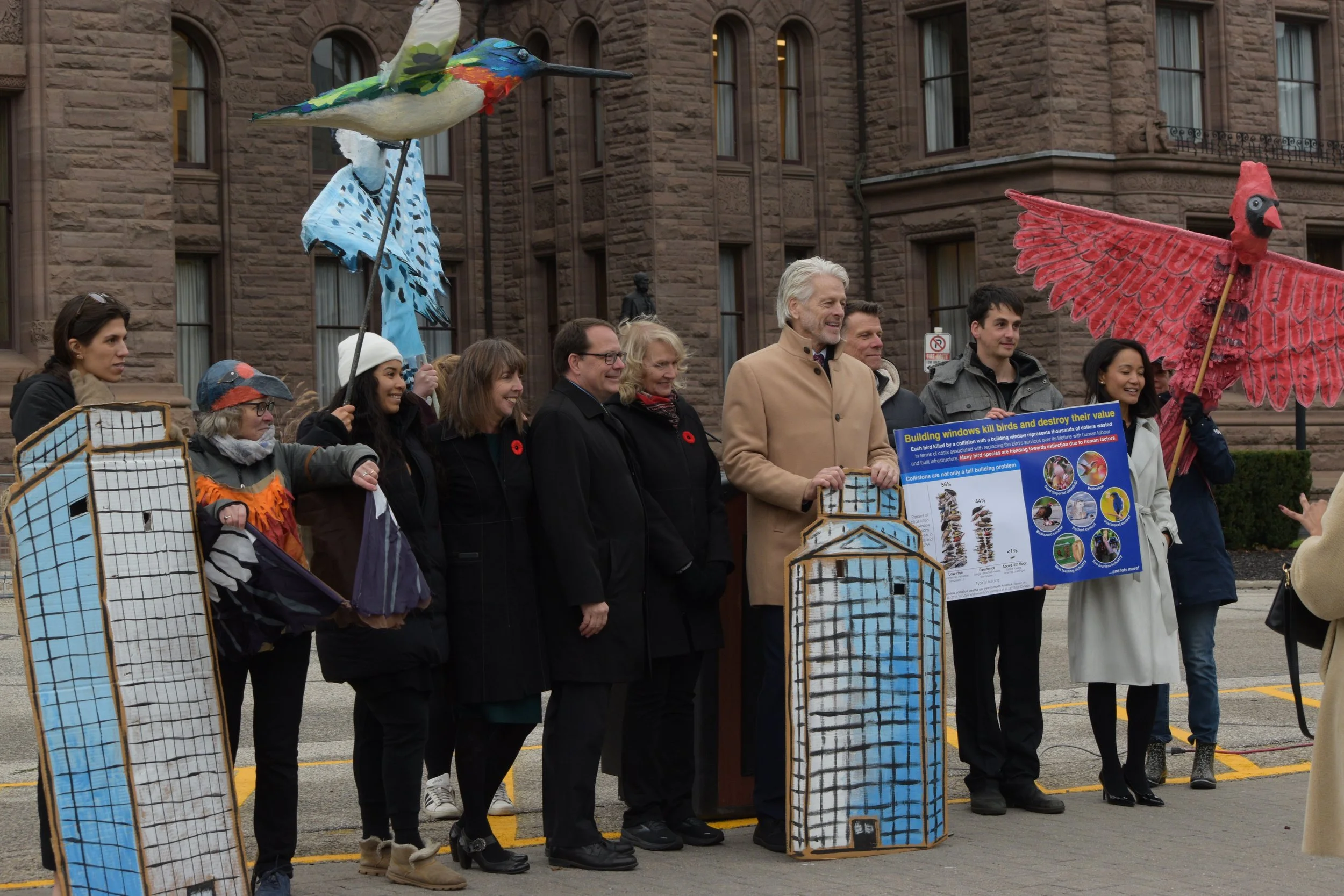
FLAP co-organized rallies at Queen’s Park where the Ontario government sits, alongside representatives from numerous political parties.